Some of the best-looking bluestone work we see isn't a patio at all. It's a lawn with stone in it. Large square pavers, set on a grid, turned 45 degrees to the house, with a strip of turf around every piece. From a distance it reads as pattern; up close it's a soft, walkable surface that drains like a lawn and stays cooler than solid paving.
The project in these photographs uses thermal Pennsylvania Bluestone, 24″ × 24″ × 2″, set diamond-fashion between a lap pool and the house, with cream limestone steps and coping alongside. Here's what makes it work.
Why 24″ × 24″ squares, and why 2″ thick.
In a solid patio every paver leans on its neighbors. In a grass-joint layout each one stands alone, so the stone has to do all the structural work itself: resist tipping underfoot, stay level through wet and dry seasons, and shrug off the mower. That's why we recommend 2″ for grass joints even though a dry-laid patio is usually fine at 1½″. The extra half-inch adds weight and stiffness, and a heavier piece stays put.
Size matters for the same reason. 24″ × 24″ is large enough to feel like a surface rather than a string of stepping stones, and heavy enough to sit still. Smaller squares in turf tend to read busy and shift more.
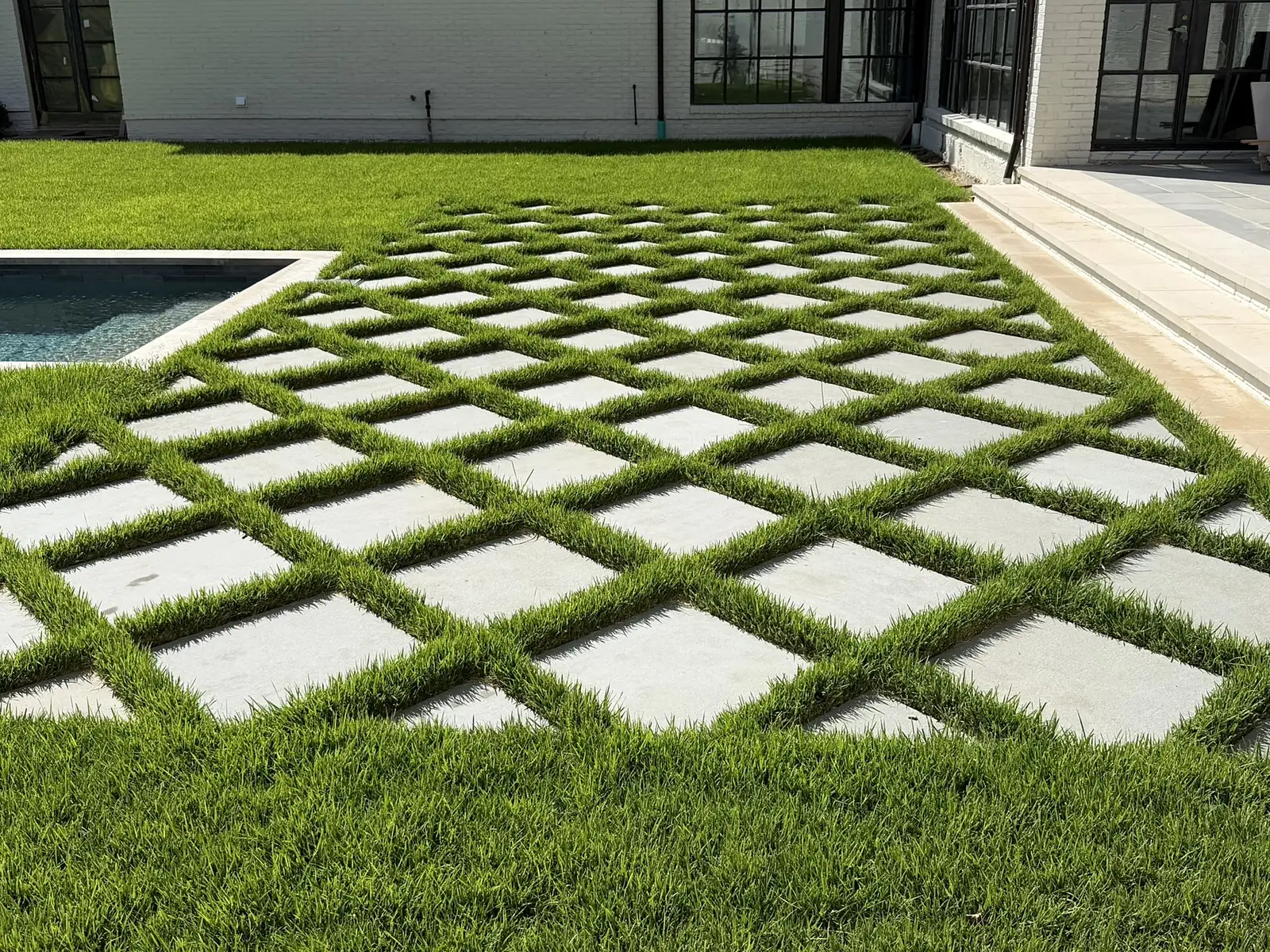
Thermal, not cleft.
A diamond grid is a graphic pattern, and it looks best when every square is a clean, flat plane. The thermal finish gives exactly that: an even, fine-textured surface with consistent color. It's also comfortable for bare feet coming out of the pool. Natural cleft works in grass too, but the gentle ripples of a split face suit a looser, more informal layout better.
The joint: 3 to 4 inches of soil.
Grass needs room to live. A joint of roughly 3″ to 4″ holds enough soil for healthy roots and reads clearly from a distance; narrower strips struggle and brown out in a Texas summer. A spreading turf that runs by stolons, such as zoysia or Bermuda, knits into the joints on its own and stays tidy.
- Set each stone on its own compacted base, so it won't sink as the soil around it settles.
- Keep the top of the stone slightly below the grass, so mower blades pass over it without catching an edge.
- Fill the joints with good topsoil, not base material, so the turf can take hold.
How many pieces to order.
Grass joints change the math, because the stone only covers part of the area. Each 24″ × 24″ square with a 4″ joint occupies a 28″ × 28″ cell, about 5.4 sq ft, of which 4 sq ft is stone. So the stone covers roughly three-quarters of the field.
| Joint width | Cell per piece | Pieces per 100 sq ft | Stone coverage |
|---|---|---|---|
| 3″ | 27″ × 27″ | about 20 | ~79% |
| 4″ | 28″ × 28″ | about 18 | ~73% |
Then add waste. A diamond field has cut pieces along every edge, so plan on about 20% extra (our estimating guide walks through it). The half-squares and triangles at the perimeter come out of those extras.
Big stone, generous joints, and a clean edge: the three things that make a grass grid look intentional.
Finishing the edges.
A diamond grid needs something straight to stop against. Here it's the pool coping on one side and the limestone steps on the other, which gives the field a crisp frame. Without a hard edge, a clean steel or stone lawn edging line does the same job.
Planning something similar? Send us the rough dimensions and your joint width and we'll work out the piece count, cuts, and waste for you.