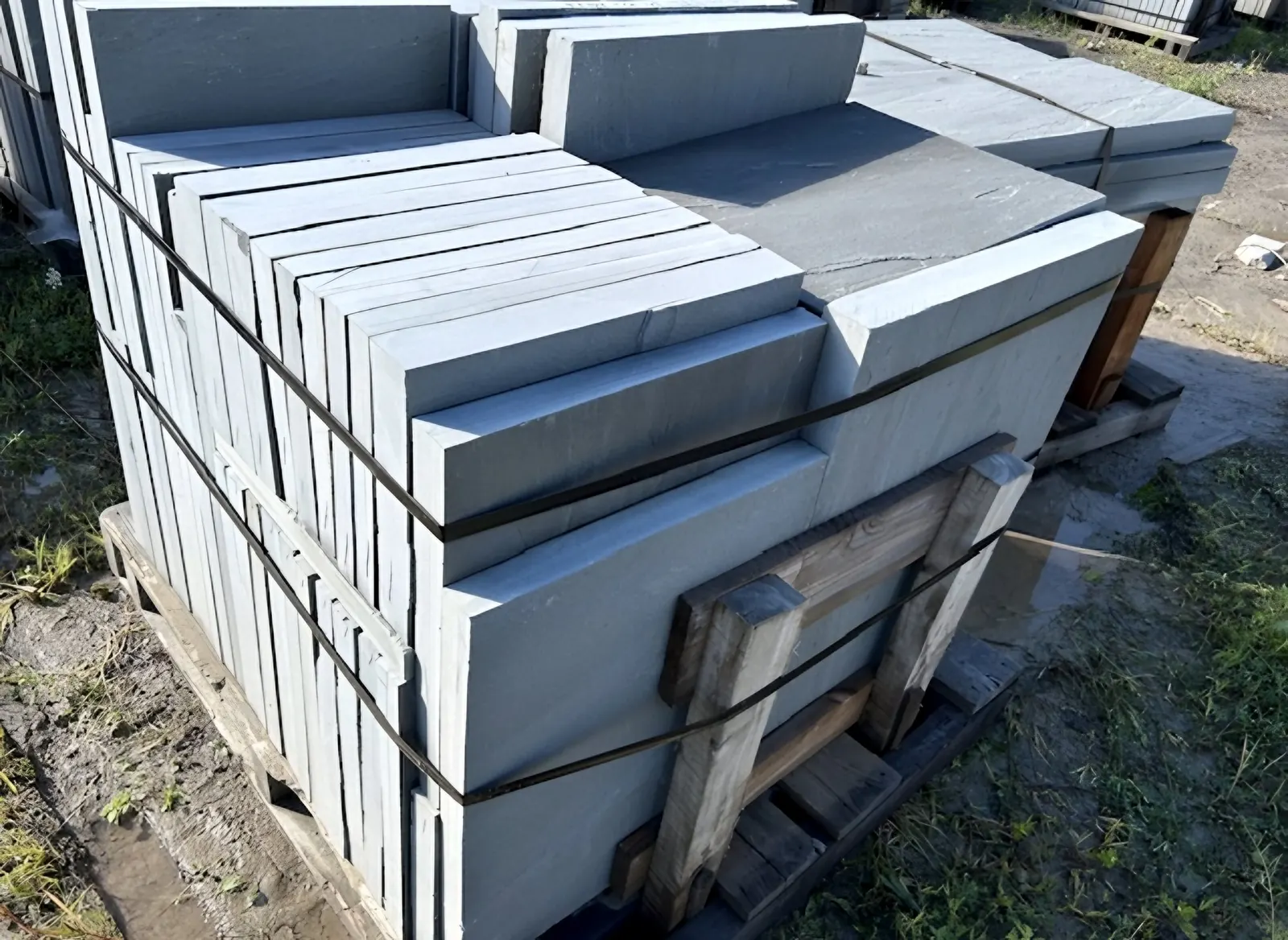
If there's one bluestone product that does most of the work on residential patios, it's this one: Pennsylvania Bluestone, natural cleft, 1½″ thick. These photos show what it looks like before it's a patio, standing on edge in crates, the way it travels from the quarry to the job.
What 1½″ is for.
Thickness follows the base. On a concrete slab, 1″ stone set in mortar is enough, because the slab carries the load. On a compacted gravel or screenings base with no concrete, the stone has to carry itself, and 1½″ is the thickness that stays flat and solid for decades. That makes it our default for dry-laid patios, walkways, and most pool decks. (The full rule is in our thickness guide.)
What "natural cleft" means.
Bluestone forms in thin layers, and natural cleft is the face you get when the stone is split along one of them. It isn't sawn or flamed on top, so it keeps the quarry's own surface: gentle ripples, subtle ridges, and more color movement than a thermal finish. The edges are sawn, so dimensional pieces still fit together in a clean pattern.
Because the face is split rather than cut, thickness varies a little from piece to piece. That's normal. Installers adjust the bed under each stone as they set it, which is part of why cleft stone looks hand-laid.
Why it ships on edge.
Dimensional bluestone is packed standing up in wooden crates, banded with steel or poly strapping and braced with timber. Stacking flat would put the weight of the whole load on the bottom pieces; on edge, every piece carries only itself, and the edges are protected in transit.
It's heavy. Bluestone runs about 20 lb per square foot at 1½″, so a full crate can easily top a ton. Plan for a forklift at the site, or a delivery truck with its own lift, and a firm, level spot to set it down.
What to check when it lands.
- Count and sizes. Check the crate against the packing list before the driver leaves.
- Edges and corners. A chipped piece or two is normal and covered by your waste allowance. More than that, photograph it and call us.
- Color. Pull a few pieces from different spots and lay them out. Natural stone varies, and it's easier to blend across crates than to fix a patch later.
- Storage. Keep crates strapped and upright until you use them, and cover them if they'll sit for a while so the stone stays clean.
Thickness follows the base. On gravel, 1½″ is the answer for almost every patio.
Want to see it before you order? We send free samples in both Blue Select and Full Color, natural cleft and thermal, so you can hold them against your house and planting.